What Is Machine Learning?
Dive into machine learning (ML) and discover the basics, how it works, types of ML, and more.
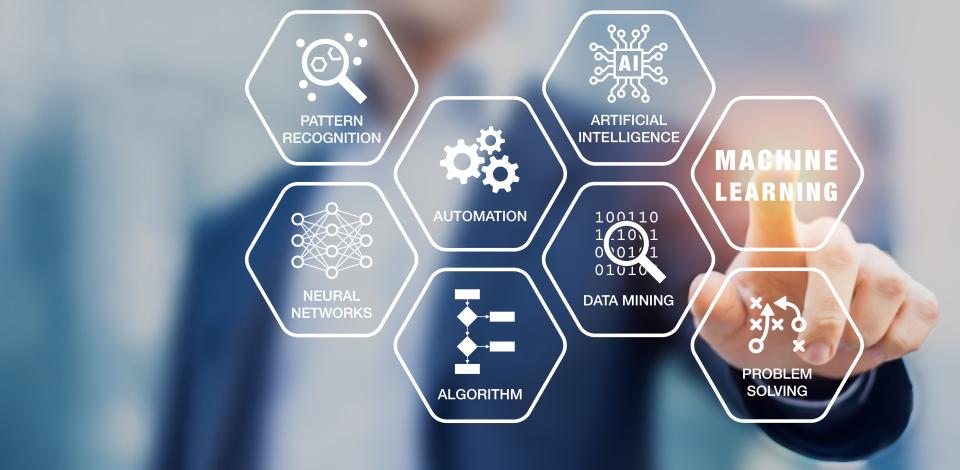
Machine learning (ML) has become a foundational technology behind many of today’s most advanced digital systems, influencing how organizations analyze data, automate decisions, and improve performance over time. Rather than relying solely on static rules or predefined logic, machine learning enables systems to identify patterns and adapt as new information becomes available. This shift has expanded the practical reach of artificial intelligence, allowing it to move beyond simple task automation and toward more dynamic, data-driven problem solving.
As machine learning continues to mature, its applications are spreading across industries ranging from finance and healthcare to education, manufacturing, and marketing. Organizations increasingly rely on ML-powered systems to uncover insights, support complex decision-making, and respond to changing conditions at scale. Understanding how machine learning works and how it fits within the broader AI landscape has become essential for professionals looking to keep pace with emerging technologies and evolving business strategies.
Understanding the Basics of Machine Learning
The term 'artificial intelligence' describes computing systems that can perform tasks typically associated with human abilities (like creativity, critical thinking, and communication). AI systems can tackle requests involving a wide range of inputs (from written text to transforming sensor data to images) to identify patterns, provide insights, and support decision-making processes.
Many AI systems still require explicit programming, which can lead to significant limitations. Rule-based chatbots (even if AI-powered) can only respond to scenarios clearly anticipated by programmers; any time interactions diverge from these narrow situations, systems may struggle to discern user intent and be unable to adapt accordingly.
So, what is machine learning? ML represents a subset of artificial intelligence, but it replaces direct coding with models that can 'learn' based on patterns observed in data. As ML algorithms are exposed to new data, they adjust.
How Machine Learning Works: Machine Learning Basics
Machine learning depends on data to train algorithms capable of recognizing patterns. Models identify relationships and adjust parameters, improving their performance in response to new information and changing conditions. H3: The Learning Process
While machine learning is often compared to human learning, it relies on identifying statistical patterns rather than conscious understanding. ML systems improve through structured training and refinement, guided by carefully prepared data and clearly defined objectives.
Key elements of the learning process include:
- Data collection and preparation: ML systems require large, relevant datasets sourced from areas such as user interactions, sensors, or public data, guided by quality and ethical standards.
- Data preprocessing: Raw data is cleaned, filtered, and normalized to reduce bias and ensure features contribute evenly during training.
- Model training: Algorithms learn by adjusting parameters based on training data, refining outputs until performance meets defined accuracy thresholds.
- Testing and evaluation: Models are tested against new data to validate reliability and performance before deployment.
- Continuous improvement: ML systems continue to learn after deployment through retraining and exposure to updated data.
Key Components
Each step in the learning process, from data preparation to continuous improvement, relies on a few core components that enable machine learning systems to identify patterns and generate predictions.
- Algorithms –Methods that determine how ML systems process data. These function as instructions, revealing how models should detect patterns or produce predictions. Common algorithm types include decision trees and neural networks.
- Data – Measurable input such as text, numbers, or images. Training data is used to teach models, while validation data tunes parameters and test data evaluates performance.
- Models – Tools that can be deployed to make predictions and support informed decision-making. Resources from Google for Developers define a model as a "mathematical relationship derived from data" and eventually used to make predictions.
Types of Machine Learning
Understanding the types of machine learning begins with recognizing the different forms of data — specifically, labeled and unlabeled. Labeled data provides corresponding outputs for each input so that learning models maintain clear reference points. Unlabeled data does not provide such explicit outputs, so correct answers remain unknown. Typically, labeled data is utilized for supervised learning, while unlabeled data supports unsupervised learning.
- Supervised learning – Trained on labeled data in which all inputs are accompanied by known outputs, supervised learning aims to limit differences between predicted and actual outputs. This could involve regression (in which models predict continuous outcomes) or classification (linking input to predefined categories). Examples include spam detection or image classification.
- Unsupervised learning – Lacking predefined answers, unsupervised learning works with unlabeled data to reveal hidden structures or relationships. This approach is well-suited to discovery, as it explores insights that are not explicitly provided. Clustering is a common form of unsupervised learning, where data is organized into similar groups. Examples include customer segmentation and anomaly detection.
- Reinforcement learning – Focused on interactions with environments, reinforcement learning employs a trial-and-error approach (accompanied by rewards or penalties). IBM clarifies that reinforcement approaches "learn to act," even imitating "real-world biological learning methods through positive reinforcement." Examples may include robotics, gaming, or autonomous vehicles.
Applications of Machine Learning
Machine learning has been deployed at scale across a range of sectors and specializations, and businesses are leveraging advanced models to improve everything from efficiency to customer service. Industry-specific applications include:
- Healthcare – Analyzing a wealth of information from electronic health records (EHRs) and other sources, machine learning serves numerous functions within modern healthcare: personalizing treatment plans, expediting or predicting diagnoses, and even accelerating drug discovery.
- Finance – From fraud detection to personalization in fintech, the finance industry relies on machine learning for various purposes — including forecasting market changes and identifying unusual patterns to better serve and protect customers.
- Manufacturing – ML-powered predictive analytics help manufacturers forecast demand and respond accordingly. Meanwhile, predictive maintenance prevents breakdowns, thereby limiting downtime so that production lines may become as efficient and productive as possible.
- Education – Adaptive learning systems introduce compelling opportunities to both K-12 and higher education, in particular amplifying online and hybrid systems so they feel personalized and immersive. Machine learning allows these solutions to draw upon data surrounding student performance or event engagement to adapt learning experiences based on individual needs or preferences.
Machine Learning vs. Artificial Intelligence vs. Deep Learning
As established above, machine learning technically qualifies as a subset of artificial intelligence. Still, it is important to compare and contrast these technologies, as ML holds capabilities above and beyond 'traditional' or 'basic' AI. Chief among them is the ability of ML to learn from data while seeing significant improvements in performance over time.
Machine learning falls under the umbrella of artificial intelligence, but it, too, has subcategories. Perhaps the most notable: deep learning, which is powered by multilayered neural networks. This involves several layers, creating (as IBM explains) a "distributed, highly flexible and adjustable structure" that delivers greater versatility.
“Artificial intelligence aims to create systems capable of intelligent behavior,” says Polo Chau, Associate Director of Georgia Tech’s Master of Science in Analytics program and instructor in the online program. “Machine learning is a crucial approach to achieving this, enabling systems to learn from data and enhance their performance with experience. Deep learning takes this further by employing layered neural networks to capture complex patterns, though often making their decisions harder to interpret.”
Getting Started in Machine Learning
AI and ML competencies are in high demand, yet it takes considerable time and effort to master these complex technologies. That’s why building foundational skills that will remain relevant across the spectrum of AI for years to come is a solid way to start. Programming skills are especially essential, with languages like Python and R supporting data manipulation and statistical modeling.
Math topics such as linear algebra, probability, optimization, and statistics are also worth exploring, as these underpin key algorithms and optimization strategies. Durable skills like project management and problem-solving also necessary. These building blocks should ideally be accompanied by extensive practice using tools such as TensorFlow, Scikit-learn, or PyTorch.
While it's possible to explore AI and ML individually, structured programs can make the technological learning curve seem less daunting. Online courses and certificates promote rapid skill development, while degree programs offer the chance to gain well-rounded, industry-respected training.
Discover the Future of Machine Learning With Georgia Tech Professional Education
Embrace cutting-edge technologies and develop a tech-focused skill set with Georgia Tech Professional Education (GTPE). Explore modular, hands-on instruction via the Georgia Tech FlexStack, which presents upskilling opportunities through industry-relevant certificate programs. Contact us today to learn more about how cutting-edge learning opportunities could position you for success in the technological landscape of tomorrow.
Digital Producer: Kat Bell