AI’s Role in Project Management
Georgia Tech project management instructors and members of the PMI Atlanta chapter recently gathered to discuss how to use artificial intelligence effectively and responsibly.
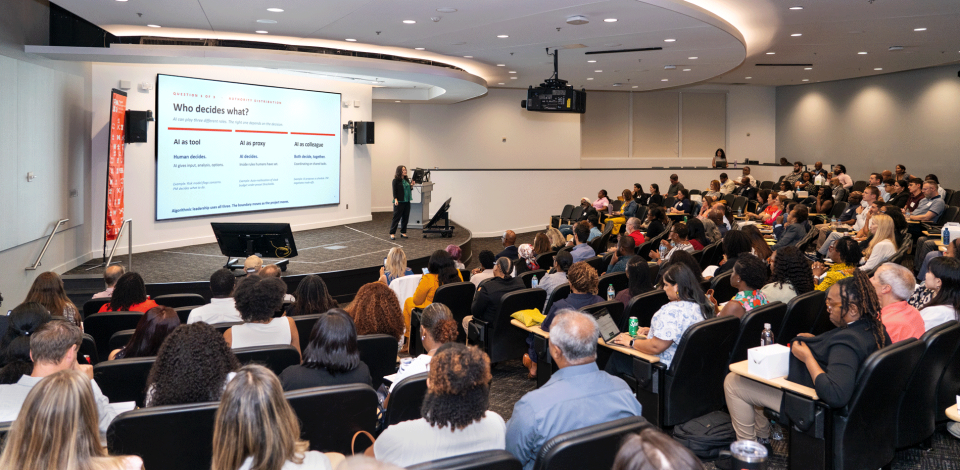
“Remain skeptical and let the data drive your decisions.” That is what project management instructor Kizmet Charles told attendees during her session, Optimize Before You Automate, at a recent PMI professional development day held at Georgia Tech’s Global Learning Center.
The event offered over 200 project management professionals opportunities to reflect on AI’s limitations, advantages, and challenges, learn about emerging trends, and expand their professional networks. Shawn Liu, clinical assistant professor of management at Georgia State’s J. Mack Robinson College of Business, delivered the keynote presentation, offering project managers practical perspectives for navigating hybrid human-AI work environments.
In a world that seems to encourage rapid adoption, Charles urged professionals to take pause and ask whether a process requires automation in the first place. “A lot of organizations are measuring AI success by usage, but as project managers, we know our job is to deliver positive outcomes. We want to create value,” she said.
Charles also challenged attendees to rethink how they evaluate AI success. Before introducing AI, project managers should map their processes and determine which activities add value and which do not. “If you have a broken process, AI is just going to amplify it,” she stressed. “We need to focus on the ways we think about non-value-added work to become effective as PMs,” she said, encouraging attendees to avoid seeking a solution right away.
Sarv Kohli, project management instructor and research lead, led a conversation on the evolving role of AI in project and organizational leadership and the frameworks needed to ensure AI initiatives deliver competitive advantages rather than isolated wins.
“AI initiatives are like a New Year's gym membership. There's massive enthusiasm on Jan. 1, but by Jan. 31, you realize that real transformation doesn't come easily,” Kohli said.
Kohli spent time walking attendees through a framework to address challenges and encouraged the audience to participate through live polling. “AI initiatives are not traditional projects. They are expensive, ongoing, and unpredictable.”
He emphasized the importance of recognizing that AI transformation isn’t a technology challenge. "It’s an operating model challenge that requires completely redesigning workflows, incentives, and ownership around outcomes," he said.
To close out the event, Glenn Itliong, a senior project manager specializing in software as a service (SaaS) and IT implementations across global markets, provided guidance on preparing for the Cognitive Project Management in AI (CPMAI) certification. Itliong shared strategies for connecting theoretical AI principles to real-world cases and approaching scenario-based questions with confidence.
Interested in leveling up your skills, preparing for PMI exams, or earning professional development units (PDUs) to maintain your credentials? Our programs are designed to support your professional growth. Learn more about our offerings here.

AI Can’t Do Everything: Why Humans Will Always Matter